
How To: Court Hearings
Attending court hearings can be nerve-wracking, especially when you're representing yourself. We have a section with a range of techniques to support you to be grounded and able to confidently approach your court hearing. Hearings often feel unfamiliar, formal and can heighten emotion and anxiety, this section is designed to help you understand your rights in hearings and what access arrangements you have the right to ask for to enable you to fully participate in the court process.
We explain the types of hearings held in court, what the court can and cannot do in these hearings and signposts to appropriate services if you need further support. This section aims to give you confidence to assert your rights, give you confidence to participate and ask questions, because access to justice should be possible for everyone.
What documents do I need for each hearing?
For each hearing there are certain documents that must be submitted:
THE 'BUNDLE'
This is the master document required under the Family Procedure Rules 2010 and Practice Directions 27A.
It is required for every hearing.
If you are the applicant you will organise the bundle and speak to your ex-partner / solicitor to agree on the documents that will go into the bundle.
There are documents that must be in the bundle and there are some that are negotiated between you and your ex partner.
See our full guide for more information.
YOUR POSITION STATEMENT
This is your opportunity to frame the case for the magistrates/judge.
It is required for every hearing.
You need to:
Clearly set out the issues in your case
Outline why you had to come to court
Actions you've taken as a parent to support your children and achieve agreement outside of court
Provide a clear 'ask' of the court - what do you want them to do?
COURT PLAN
This document will help you present your case clearly and fairly as a litigant in person.
You can print it before your hearing and read from it in court.
It will set out the key issues of your case, evidence and child welfare considerations, including key questions you may want to ask the judge and have the court address.
With a plan of what you want to say in court you can be more confident in stating the key evidence and key points in your case.
Rights to Adjustments
TRANSLATIONS
Your right to an interpreter
What the law says
Article 6 of the European Convention on Human Rights (ECHR) says that courts must ensure you can understand and participate in proceedings.
The Equality Act 2010 says that the courts have a duty to not discriminate against anyone that has a language barrier.
What the court must do
The Family Procedure Rules 2010 (Part 1) require the court to deal with cases justly and fairly, which includes ensuring that you understand the process, including access to an interpreter.
The court provides interpreters often for free, but you must request this service from the court.
How you can ask
You can request an interpreter when making your application (on the C100 form).
If you have difficulty with written English, courts can arrange translations of core documents.
The court must ensure you can understand, respond, and present your case.
See our C100 walkthrough video on 'Preparing Court Forms'
REASONABLE ADJUSTMENTS
Your right to reasonable adjustments
What the law says
The Equality Act 2010 says that the courts have a duty to make adjustments so that if you need reasonable adjustments, you
are not disadvantaged in court.
If you have a physical accessibility need, communication need, emotional or psychological need, the court must recognise and accommodate you.
What the court must do
The court must provide appropriate support such as:
Accessible toilets
Breaks during a hearing to help with concentration
British Sign Language (BSL) interpreters
forms in large print
Guidance in alternative formats including audio and Easy Read
Hearing enhancement equipment
This doesn’t include everything the court can do to help as everyone has different and individual needs.
How you can ask
You must tell the court as early as possible if you need adjustments by contacting the court and on your C100 form.
Use medical evidence if possible, but you do not have to prove your disability, only explain your needs. In the hearing you have the right to remind the judge about agreed adjustments, you should not feel guilty about asking.
ABUSE VICTIMS
Your right to be protected
What the law says
The Domestic Abuse Act (2021) recognises that victims and survivors of domestic abuse (including children) are entitled to protection in the family courts.
The Human Rights Act (1998) also ensures your safety and dignity in proceedings under Article 3 and Article 8.
What the court must do
The court makes clear that survivors should not:
Be directly cross-examined by their abuser, the court can appoint a qualified advocate if requested.
Give evidence safely by providing screens, separate entrances and exits or giving evidence via video link.
If there is a risk of harm to your children and you, the judge must consider any allegations of harm and make safeguarding a priority when making child arrangements.
How you can ask
Along with your C100 form, submit a C1A to set out concerns of harm or domestic abuse
Types of Hearings
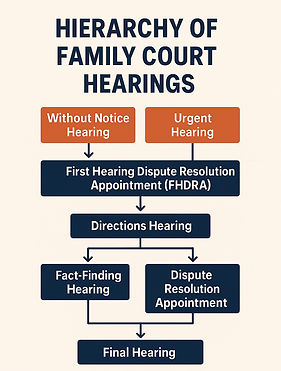
Each type of hearing has a different purpose and intended outcome. It's important to note the difference between the hearing types so you are prepared to assert your rights, ask the right questions and know what to expect.


UNDERSTANDING A HEARING NOTICE
A hearing notice is the official notice from the court to tell you the date, time and type of court hearing you are going to have. It can feel very overwhelming to receive, especially if you are the Respondent (and have not applied to court) or representing yourself. The hearing notice does not mean the court has made decisions, they are setting out the timetable, or 'case management' of your case.
A notice will usually include:
Date & Time of the hearing
Location of the court
Type of hearing e.g FHDRA
Instructions for you to bring documents or complete tasks before the hearing
Who will be hearing your case e.g. Magistrate or Judge
It is a requirement to attend, it is not optional. If you cannot attend, you must inform the court in writing as soon as possible. Courts will not usually re-list a hearing unless there's a strong reason to do so. If you are worried because of your ex partners behaviour or abuse, see our 'Rights to Adjustments' here.
You will now need to prepare your Position Statement, Bundle documents and communicate with your ex partners solicitors to agree which documents will be entered into the bundle.
Self Representing at Hearings
Judges are allowed to talk directly to me
The Equal Treatment Bench Book (2023)
“Judges must be aware of the feelings and difficulties experienced by litigants in person"
Judges are expected to treat self-representing litigants (Litigants in Person) fairly. They should communicate with you in a supportive and neutral way.
A judges role is to ensure fairness in the proceedings by:
Explaining the process clearly to you
Asking questions in an easy and accessible way
Give you an opportunity to present your case
Barristers & Solicitors must:
Not take unfair advantage of you because you are a LiP
Assist you in the court in the spirit of fairness and justice. This does not mean you can ask your ex partners representative for advice, but they are expected to behave courteously toward you and can clarify anything you don't understand.
You must be treated with impartiality, patience and courtesy through the whole process.
Preparing for a FHDRA and/or
Directions Hearing
A judge may order various actions within a specific time frame before you return to court for a Final Hearing:
You may be ordered to submit an additional statement for the next hearing giving further details to the judge to help them make decisions.
A judge may 'direct' (i.e. order a person or organisation to do something) for the GP to send your child's medical records to court as evidence. They may direct your child's school to send a statement or safeguarding records to the court, for example.
At ANY stage of the court process, the judge may order you and your ex partner to attend mediation, if they feel that this may resolve the dispute without a full court hearing.
If relevant, the judge may order CAFCASS to make an assessment of the current child arrangements in order to decide what would be in the best interests of the child(ren) going forward.
In your position statement you can ask the judge to 'direct' for certain evidence to be admitted into the case if it's relevant. For example if in the time between you submitting your first application and the hearing, you have taken your child to the GP or hospital because of your ex partner physicially abusing them, you can ask the judge to release that record to the court.
What Comes After a Directions Hearing?
Depending on the directions (orders) given by the judge, several things can happen after the hearing:
The judge may 'set' (organise) additional hearings in order to review progress or resolve outstanding issues. These are typically called Dispute Resolution Appointments or Pre Hearing Reviews. If you have a lot of issues in your case or there is a lot of evidence to go through, they will try to resolve as many issues as possible before you reach a Final Hearing.
If you cannot agree on the issues and there are safeguarding issues or domestic abuse or domestic violence allegations, the judge may order a 'Fact Finding' hearing as part of their directions in the Directions Hearing.
If the judge feels they want you to try and resolve your issues outside of court, they may order you and your ex partner to try a form of Non Court Dispute Resolution, normally mediation. You will have to attend a session with a mediator before the next hearing.
A judge may make 'interim' (temporary) orders that remain in place until the final hearing is held. For example, if you've raised issues of domestic abuse in your application, the judge may order contact in a contact centre between your ex partner and your children.
After a directions hearing you must follow the orders that the judge has given until the next hearing.
What is a Fact Finding Hearing?
A 'Fact Finding Hearing' is the hearing where both parties present their evidence to the judge to help them decide on what is 'factual' in your case.
In this hearing, you may be asked to sit in the witness stand and you will be asked questions by your ex-partner's counsel, their solicitor or barrister, about any issues or concerns you have raised. Your ex partner will also have to answer questions, from you or your counsel.
It is important that if you have submitted a C1A (which outlines issues of abuse) you have the right to not be questioned by your abuser or abuser's barrister in court under provisions in the Domestic Abuse Act 2021.
The court will send the appropriate form with the court order, before a Fact Finding hearing to prevent you from being questioned.
What happens in a Fact Finding Hearing?
Both you and your ex partner will present evidence to the judge, this could include witness statements, expert reports, GP records.
Depending on the complexity of your case and the issues that you are trying to resolve, this process could take one to a several days.
What can I expect from the Judge during a Fact Finding Hearing?
The judge will take into account everything that’s presented, including the wellbeing of your children, by weighing up all the evidence before determining a 'finding of fact'.
It's important to remember that the evidence is not treated like a criminal case i.e. 'beyond a reasonable doubt' but on 'the balance of probabilities' as to whether something did or did not happen.
The judge may ask you or your ex partner to clarify the facts of the case. If you are cross-examined, you can take your time to reply and form your answer.
Use our Court Plan to help you
After all the evidence is presented, the judge will make an order for what happens next. Depending on the complexity of your case, they may rule some evidence as a 'finding of fact' or may reserve their decision for a later date.
The judge will then schedule a Final Hearing.
What Happens at a Final Hearing?
The Final Hearing is where the judge makes the last and binding decision in your case. You will receive a Final Order after this hearing setting out what the court has decided in terms of the arrangements you are seeking.
You have a final opportunity to present your case in your position statement and to the court before the judge makes a decision.
Decisions are based on the child’s welfare, guided by the 'welfare checklist' in the Children Act 1989, s.1(3).
You must follow the order once it is made.
After the hearing, if you are self representing you will be writing the order with your ex partner's counsel or the judge may help you if you are both self representing.
See our guide on how to write court orders:
If you think there’s been a serious mistake, you can appeal, but appeals are only possible in limited circumstances.
See the Appeals guidance for more information
Key Tips at Court Hearings
Take notes
It is essential that you take notes in the hearing. Especially if you are writing a court order with your ex partners barrister by yourself.
You and/or your McKenzie Friend should take notes of what is said and most importantly, agreed.
If you want to appeal a decision it is also essential to have accurate notes.
If you have an accessibility requirement and need someone to take notes, inform the court on your C100 Form and/or write to/ phone the court.
Don't lose your cool
Court hearings can be overwhelming and emotional but it's important to remain focused on the facts of your case and presenting your evidence in a non emotional way.
Judges and legal professionals should treat you with respect at all times, don't be afraid to state when you feel uncomfortable, or to ask for a break, especially if you have additional needs.
If you're unsure about anything, don't be afraid to ask the judge during the process for clarification. You have the right to participate in proceedings in a way that ensures your full understanding of what is happening.
Use our Family Court Guide to ensure you have all relevant documents and that you have prepared:
Your Bundle
Your Position Statement
Your Court Plan
Be clear on your goals when you go to court.
Knowing what happens in each hearing will help you ask for the right outcomes at the right time.
Be Prepared
Next Steps
1
I want to prepare for my hearing
If you're feeling ready to move forward, see our step-by-step guide on how to prepare a court bundle.
We will guide you on what documents to submit and how to organise it so the judge can follow your case clearly.
If your ex partner is being legally represented, learn how to build your confidence in court with our 'Challenging Barristers' guide.
2
I need to write a position statement
Your position statement is your voice and your story on paper. It will tell the court what you're asking for and why.
We'll help you find the right words to express your story and structure your statement to include important details without it becoming overwhelming.
3
I need further support
If the hearing is soon, our 'Court Wellbeing' section has tips on how to ground yourself.
If you have more time, visit our 'Know Your Mind' section .
If you need specialist support for domestic abuse, accessibility needs or more individual support, see our 'Specialist Services' section.